Government
Closed-door pay talks and auto-title overtime at Richland County board raise accountability questions
Richland County commissioners approved building-maintenance overtime from auto-title fees with no recorded vote, then discussed pay in closed session.
By Staff · September 25, 2026
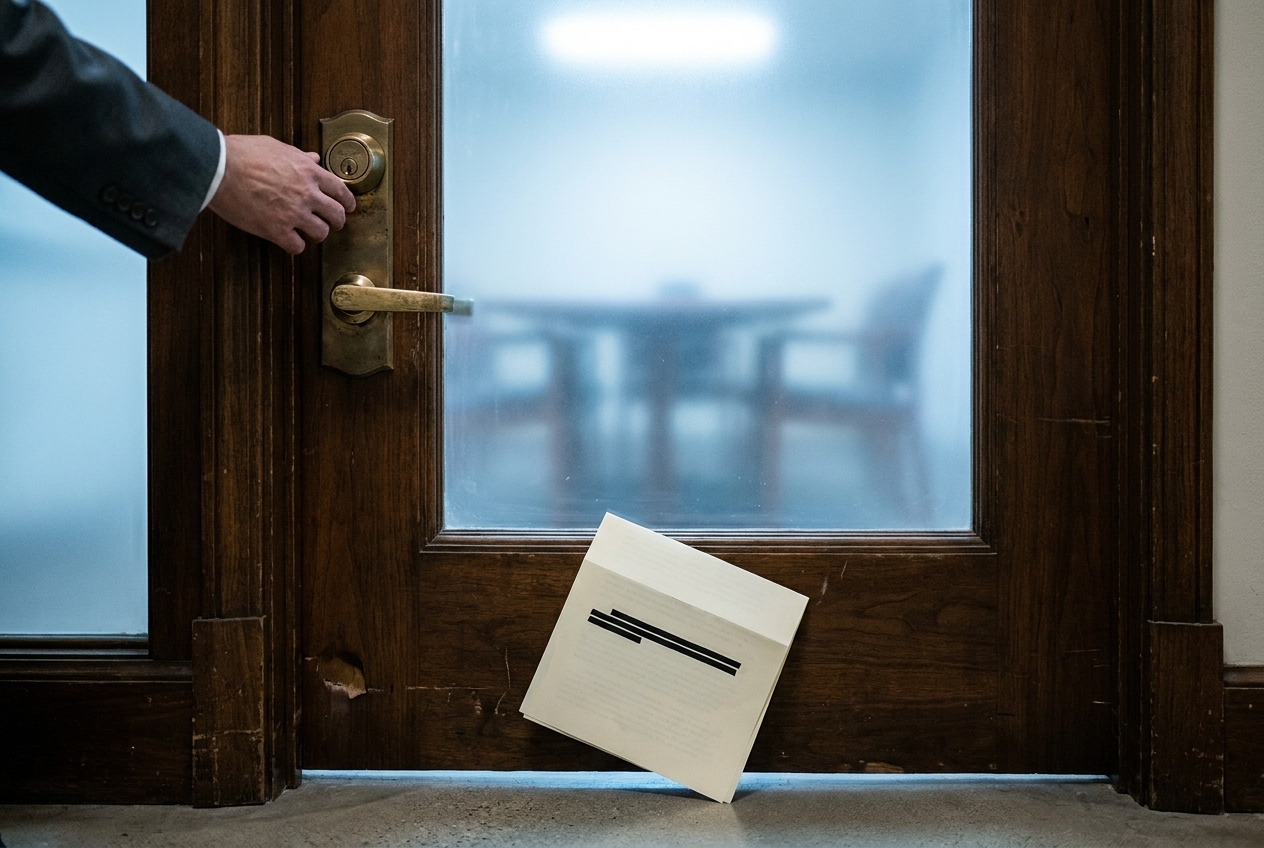
Overtime paid from auto-title funds, then a closed door on pay
Richland County commissioners approved building-maintenance overtime paid out of auto-title funds at their Sept. 18 meeting, then went into a closed executive session to discuss a public employee's compensation — leaving taxpayers to ask whose overtime got funded, why title fees are covering it, and what pay was discussed in a room they could not enter.
The board met by Zoom that Friday and handled much of its business routinely: certifying prior proceedings, approving requisitions, authorizing weekly transfer requests, and accepting a county employee's resignation. Two items stood out from the routine.
First, the board approved a resolution directing additional labor costs for building maintenance to be paid from auto-title funds. The meeting record does not state whose overtime was approved, how many hours or dollars it involved, or why auto-title dollars are the source of payment. It also records no roll-call vote on the item.
Richland County's Building Maintenance department, at 88 Park Ave. East in Mansfield, maintains county buildings. Its listed superintendent is Joshua Hicks, with several repair workers under the department.
The auto-title money traces to fees the county collects on vehicle titles, including a $15 certificate-of-title fee for motor vehicles, watercraft, and manufactured homes and a $5 late filing fee when a title is not procured within 30 days after assignment. Under Ohio Revised Code 325.33, those fees go into a Certificate of Title Administration Fund meant to pay title-processing costs and an $8,000 annual deputy-registrar pay supplement. Moving money beyond those costs to the general fund for other county purposes requires agreement between the clerk of courts and the commissioners, or a determination by the county budget commission.
The question for taxpayers is straightforward: if auto-title dollars are paying building-maintenance overtime, readers deserve to know whose overtime, how much, and under what authority the money is being routed there.
A closed door on compensation
The board then entered executive session to discuss compensation for a public employee. Under Ohio's Open Meetings Act, a public body may enter executive session only after a majority of a quorum determines, by a roll-call vote, to do so, and only for a listed purpose — including "the compensation of a public employee or official." No vote or official action may be taken in an executive session; any approval or denial of compensation must happen after the board returns to open session.
The Sept. 18 record does not record a roll-call vote for the executive session, and it does not state what pay was discussed behind the closed door. A pay decision affecting a worker's wages was discussed in a room the public could not enter, and the record leaves no public trace of the discussion.
Both items concern county employees' pay: overtime for building-maintenance workers, and compensation discussed in closed session for a public employee. The same meeting also accepted a county employee's resignation, a reminder that these are real people on the county payroll whose pay and jobs are being handled at this table.
Who answers?
The two moves sit together: public money paying workers' overtime, and workers' wages discussed behind closed doors, both decided with key details out of public view. For the workers themselves, the stakes are concrete — whether overtime is actually paid, from what pot of money, and what their compensation will be. For taxpayers, the question is whether those dollars are going where they should.
As of late September 2026, no commissioner, and the board as a whole, had publicly stated whose overtime was funded, why auto-title dollars are covering building maintenance, or what pay was discussed in the closed session.
The Gazette is pressing the board to answer three questions plainly: whose overtime got funded, why auto-title dollars are covering building maintenance, and what pay decisions were made behind closed doors.
The board meets every Tuesday and Thursday at 9:30 a.m., and its meetings are the public venue where these answers would have to be given in open session. The Gazette will report what the board says — or does not say — as the answers come in.